Agreements • Decisions • Declarations
Fix what was declared.
Exactly when it was declared.
Exactly when it was declared.
Neutral, time-sealed records — independent of all parties.
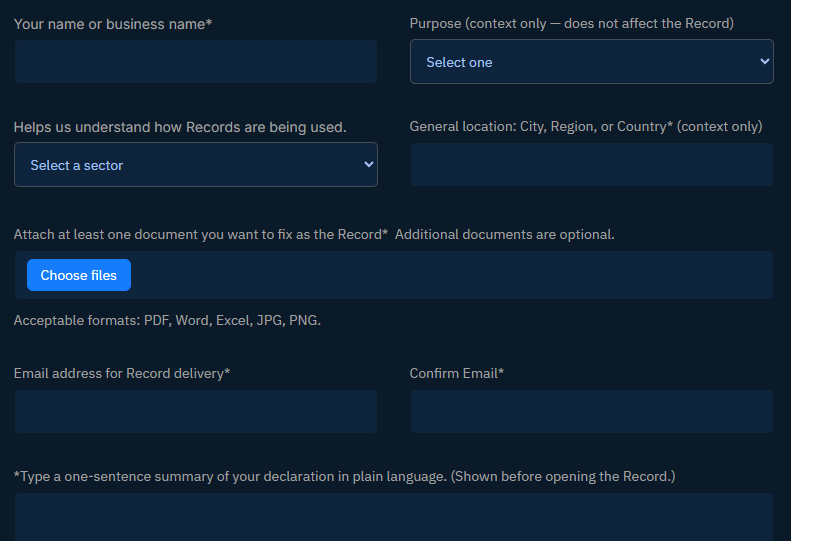
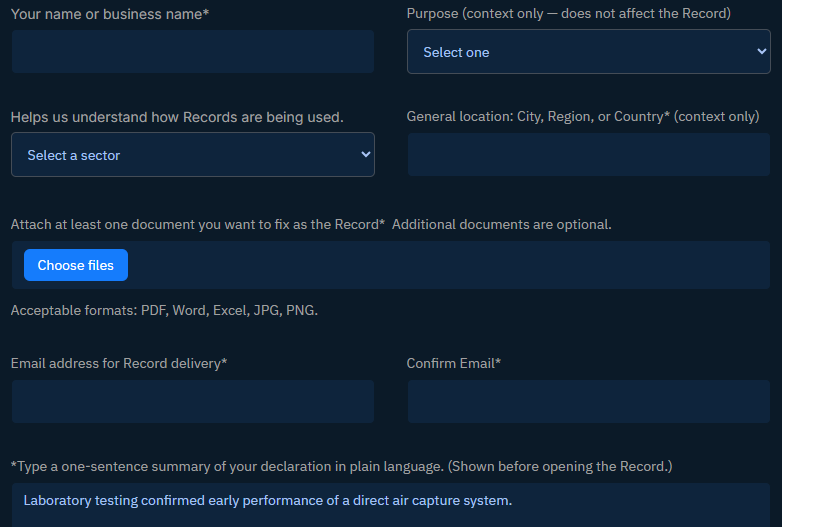
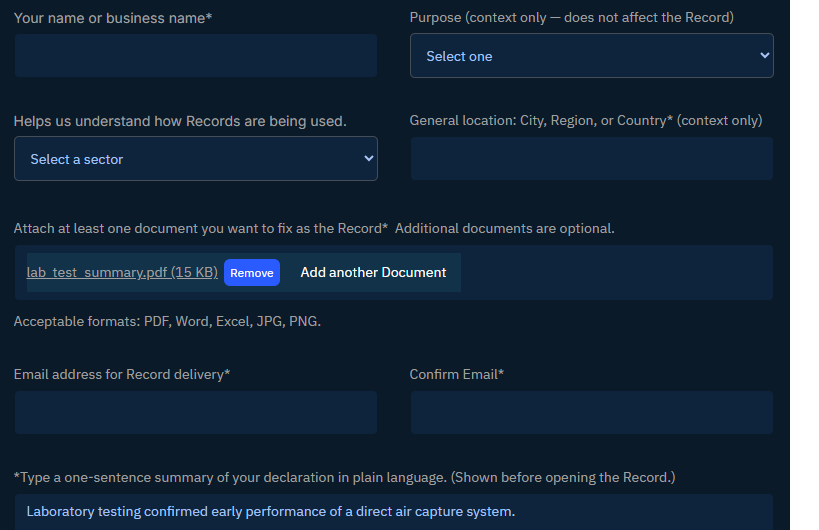
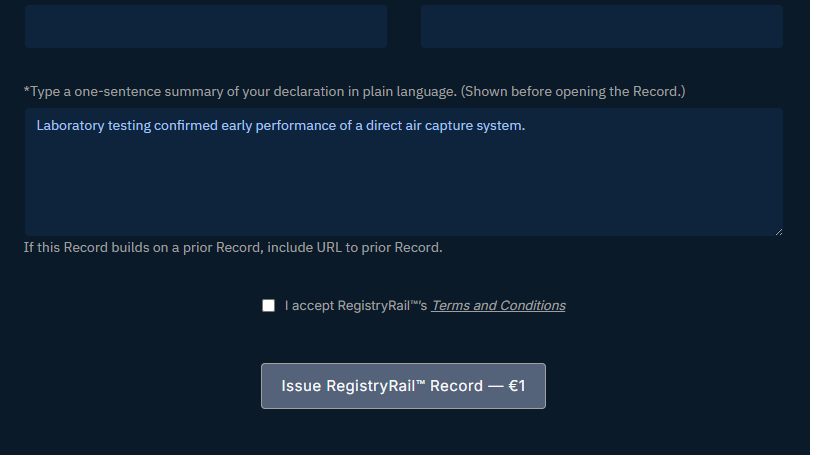
Create a Record (under 60 seconds)
No account needed • Fully automated
Just agreed terms
Sending a notice
Confirming what was decided
Setting a deadline
Declaring a milestone
Recording a commitment
Sharing a disclosure
Locking it in
Claiming progress (TRL)
Serving notice
Recording a resolution
Pitch deck locking
Regulatory Filing Made
Just agreed terms
Sending a notice
Confirming what was decided
Setting a deadline
Declaring a milestone
Recording a commitment
Sharing a disclosure
Locking it in
Claiming progress (TRL)
Serving notice
Recording a resolution
Pitch deck locking
Regulatory Filing Made
Today's record (in party systems)
.png)
• Open to revision
• Version ambiguity
RegistryRail Record (neutral custody)
.png)
• Declaration fixed at issuance
• Tamper-evident
• VisibilIty controlled by you
Put it on the record when....
— Just agreed something
— Just confirmed a deadline
— Just shared something important
The RailNeutral evidentiary custody
— outside both creator and reviewer systems.
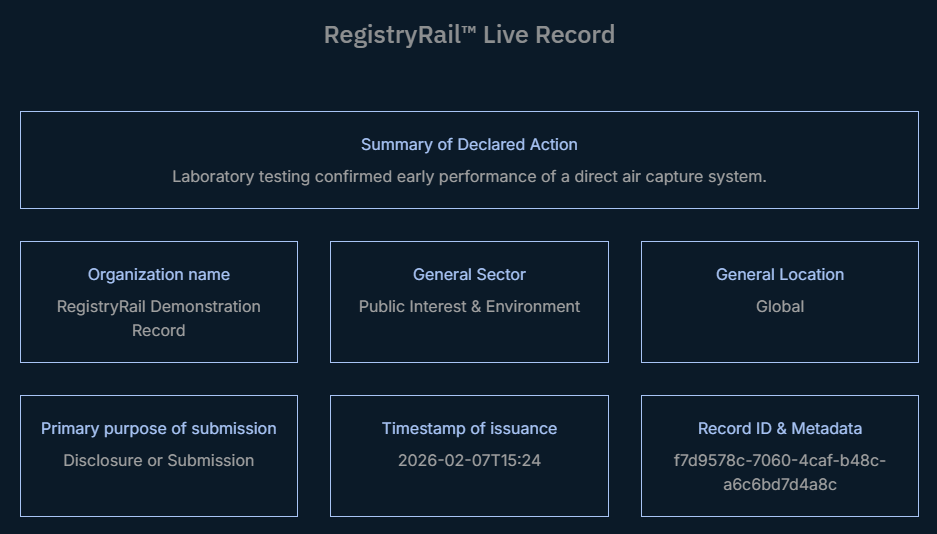
Each RegistryRail Record establishes a single authoritative reference for what was declared at that point in time.
Records can be issued instantly and stand independently, without reliance on ongoing system access.
Records may reference earlier ones, forming a clear and ordered chronology.
System Characteristics• Each Record fixes its issued state: content, timestamp, and identifiers
— Any subsequent alteration becomes detectable independently.
• Records are self-contained and independently verifiable
— The Reviewer Copy contains the hash values required for verification.
• Custody is limited to issuance and preservation
— The system does not interpret, assess, or modify submitted content.
1. Instant IssuanceA typed declaration is sufficient to create a Record. Additional attachments are optional.
Each issuance provides:
– a secure Live Record URL for access and sharing
– a sealed Reviewer Copy for independent retention
2. Sealed at CreationThe issued Record preserves the declaration and any attachments as issued.
The Reviewer Copy includes the timestamps, identifiers, and materials required for independent reference.
3. Controlled SharingCreator receives the Live Record URL by email and exclusively controls how it is shared.
The Live Record is accessible without login or integration.
The Reviewer Copy supports long-term retention and referencing.
Per Record PricingNo contracts • No lock-in • No tiers
First Record — €1
Issued once to familiarise users with the Rail
Flat fee per Record — €10
No technical integration required; Only an email address
Built for Audit & Regulatory ReadinessVerifiedClimate™ delivers Records structured for institutional scrutiny from the moment of issuance.
• RFC-3161 timestamping establishes a neutral, fixed point in time.
• SHA-256 hashing makes all content and attachments tamper-evident.
• Sealed Reviewer Copies provide a stable, review-ready PDF for workpapers.
• Non-editable Records ensure nothing can be altered after issuance.
• Consistent, standardised formatting supports efficient evidence review.
Auditors receive a complete, fixed, review-ready artefact — removing reconstruction and version uncertainty.
.png)
Grant Applications. Series A Readiness. TRL Level Validation.
Timestamped reports, milestone deliverables — forming verifiable audit trails, supporting grant decisions, early‑stage funding, and validating technical readiness for IP protection and due diligence.
.png)
ESG Reporting & Sustainability Proof Points.
Immutable records underpinning ESG updates, supplier disclosures, and sustainability reporting — strengthening trust with procurement teams, investors, and corporate stakeholders.
Public Records & Municipal Transparency.
Publicly referenceable climate project records — supporting council reporting, enabling community consultations, and strengthening civic accountability with transparent, time‑locked evidence.
Built for Audit & Regulatory ReadinessVerifiedClimate™ delivers Records structured for institutional scrutiny from the moment of issuance.
• RFC-3161 timestamping establishes a neutral, fixed point in time.
• SHA-256 hashing makes all content and attachments tamper-evident.
• Sealed Reviewer Copies provide a stable, review-ready PDF for workpapers.
• Non-editable Records ensure nothing can be altered after issuance.
• Consistent, standardised formatting supports efficient evidence review.
Auditors receive a complete, fixed, review-ready artefact — removing reconstruction and version uncertainty.
(Subsequent records €100)
ANTICIPATED REVIEWER REQUIREMENTS
Early-Stage TRL 1–3
- Concept notes and research outlines – initial scope, baseline hypotheses, and problem definition.
- Preliminary feasibility studies – early analyses supporting technical potential.
- Supporting literature reviews – peer-reviewed research, white papers, or patents cited as a foundation.
- Initial experimental data – indicative lab findings, basic proof-of-principle results.
- Optional R&D funding approvals – small-scale grants, institutional seed funding evidence.
Mid-Stage TRL Validation (TRL 4–5)
Prototype development and validation stages expected by regulators, institutional reviewers, or funding authorities include:
- Proof-of-concept validation – controlled lab test reports confirming feasibility.
- Prototype engineering documentation – schematics, Bills of Materials, build records.
- Simulation and experimental data – computational models, validation reports, raw outputs.
- Risk and compliance assessments – hazard analyses, conformity with safety standards.
- Independent expert assessment – validation reports or assessor opinions.
- Optional funding evidence – milestone reports for mid-stage grants.
Pilot-Scale Demonstrations (TRL 6–7)
Field testing, Series A funding readiness, and regulatory alignment at pilot scale typically include:
- Field trial documentation – monitored conditions, test performance reports.
- Extended compliance assessments – certifications, CE marking, hazard reports.
- Third-party evaluations – independent test or validation reports.
- Commercial feasibility studies – market readiness analysis, adoption forecasts.
- Partnership confirmations – letters of support from regulators or industrial partners.
- Gap analysis for TRL 8–9 – remaining steps to market deployment.
(TRL 8–9 market readiness is referenced in #4 below, "Guide to Governance Disclosures & Stakeholder Assurance Filings.")
Funding authorities such as Horizon Europe, Innovate UK, and U.S. DOE programmes typically expect:
- Official funding call reference – published programme identifier.
- Completed application form in required format – strictly as specified by the funding body. (Formal submission must still follow the funding authority’s channels; many organizations maintain a VerifiedClimate™ record in parallel for timestamped archival.)
- Detailed technical and impact narrative – project objectives, outcomes, alignment with programme goals.
- Structured work plan – milestones, deliverables, resource allocation.
- Budget and cost justification – eligible and co-funded costs aligned with EU or national rules.
- Organizational capacity records – staff CVs, prior experience, institutional endorsements.
- Partnership confirmations – letters of intent, consortium agreements.
- Risk management plans – registers, mitigation measures, ethical considerations.
- Regulatory and ethical approvals – environmental permits, ethics board clearance.
- Optional SME or certification proof – SME status declarations, ISO accreditations.
Disclosures aligned with CSRD, IFRS S2, or Paris Agreement frameworks typically include:
- Consolidated ESG or sustainability report – structured to CSRD or IFRS S2 guidance.
- Underlying emissions inventories – Scope 1, 2, and 3 emissions (ISO 14064-compliant).
- Supply chain due diligence – supplier codes of conduct, ESG audits, compliance declarations.
- Board-approved sustainability policies – climate transition plans, Paris Agreement alignment.
- Third-party assurance reports – limited or reasonable assurance from accredited auditors.
- Methodology statements – KPI calculation methods, materiality matrices.
- Climate risk and opportunity assessments – TCFD-aligned scenario planning.
- Year-on-year comparative ESG data – historical performance datasets.
- EU Taxonomy disclosures – alignment of turnover, CapEx, and OpEx.
- Optional investor briefing materials – ESG decks, stakeholder updates.
Board submissions, investor disclosures, and stakeholder filings typically include:
- Formal board or committee papers – resolutions, decision briefs, agenda packs.
- Risk registers and analysis – financial, operational, or environmental risks.
- Stakeholder assurance briefings – investor, shareholder, or consortium documents.
- Minutes or records of prior meetings – governance context.
- Annexed technical or financial schedules – supplementary decision-making evidence.
- Material event disclosures – updates on major governance matters.
- Updated governance policies – codes of conduct, conflict-of-interest registers.
- External assurance reports – governance audits by PwC, Deloitte, or similar.
- Legal or regulatory opinions – external counsel reviews.
- Optional oversight letters – confirmations from funders or regulators.
Offset project developers and organizations disclosing emissions reductions under the Paris Agreement, ISO 14064, or voluntary carbon standards typically include:
Public tenders and institutional procurement processes typically require:
- Official tender documentation – published tender notice, scope of work.
- Mandatory compliance certificates – ISO accreditations, tax clearances, insurances.
- Technical proposals – design specifications, implementation methodologies.
- Financial proposals – itemized pricing schedules, bid validity letters.
- Proof of organizational capacity – prior experience records, technical staff CVs.
- Supply chain due diligence – declarations of origin, ESG compliance documentation.
- Client references – endorsements from previous contracting authorities.
- Risk mitigation strategies – health & safety, environmental risk protocols.
- Signed declarations – anti-corruption, conflict-of-interest disclosures.
- Optional consortium agreements – partner or subcontractor confirmations.
Research outputs submitted for academic publication, funding reviews, or institutional archiving typically include:
- Draft or published manuscript – preprints or journal-ready articles.
- Underlying datasets – raw and processed research data.
- Statistical or computational methodologies – analysis workflows, code repositories.
- Ethical approval documentation – IRB approvals, research clearance.
- Literature review archives – key references, prior evidence.
- Peer review correspondence – reviewer feedback, responses.
- Conflict of interest disclosures – required statements for journal or funder compliance.
- Grant funding acknowledgments – evidence of financial support.
- Licensing and open-access agreements – publication rights confirmations.
- Optional supplementary materials – high-resolution figures, multimedia.
Certification bodies (ISO, FSC, LEED) and accreditation authorities typically expect:
- Certification application forms – strictly in the authority’s required format.
- Quality manuals and policies – documented management systems.
- Standard operating procedures (SOPs) – process-level documentation.
- Evidence of implementation – operational logs, training registers.
- Internal audit reports – pre-certification self-assessments.
- Corrective action plans – responses to identified gaps.
- Legal or regulatory permits – licenses required for accreditation.
- Third-party evaluation reports – external auditor findings.
- Historical certifications – records of prior accreditations.
- Optional global alignment references – UN SDGs, Paris Agreement targets.
Formal collaboration agreements and governance records generally include:
- Memoranda of Understanding (MOUs) – outlining high-level intent.
- Consortium agreements – legal collaboration terms.
- Governance frameworks – decision-making structures, escalation mechanisms.
- Financial commitments – cost-sharing arrangements.
- Risk allocation statements – liability, indemnity, insurance clauses.
- IP agreements – ownership and licensing of background/foreground IP.
- Work package definitions – partner-specific deliverables.
- Third-party endorsements – letters of support from regulators or investors.
- Contingency and withdrawal protocols – conflict resolution clauses.
- Optional communications agreements – joint branding policies.
Broader compliance filings, statutory disclosures, and regulatory submissions typically require:
- Regulatory forms and templates – prescribed by oversight bodies.
- Audited financial statements – statutory accounts, tax filings.
- Operational compliance reports – health & safety, environmental, or quality.
- Data privacy documentation – GDPR/CCPA registers, DPIAs.
- Stakeholder consultation records – public engagement summaries.
- Independent legal opinions – external counsel reviews.
- Official correspondence – communications with regulators.
- Permit renewals and licenses – documentation of authorizations.
- Assurance or attestation reports – third-party compliance verification.
- Optional voluntary disclosures – adherence to industry pledges.
Institutional Integration Options
White labelling is currently in closed beta with select institutional users.
Full rollout including branding controls, domain masking, and access options is scheduled for September 1, 2025.
To register interest, contact partners@verifiedclimate.com

Flat rate Beta pricing.
Beta pricing is fixed across all sectors at €450 per VerifiedClimate Record until September 1, 2025.
Issued records will remain continuously referenceable, with optional renewal available after 12 months.
The current beta phase supports a limited number of available entries, and remains open while capacity allows.
.avif)
Common Submissions
Average Upload Volume
Average Submission Time (minutes)
Early-stage TRL Validation (TRL 1-3). Concept notes. Evidence Proving Tech Feasability for Grant/Funding Submissions (R&D, innovation funding, and public tenders)
(12) PDF,
(4) Word (.doc/.docx),
(2) Excel (.xls/.xlsx),
(1) Image (.jpg/.png), End.
Average (18) min, End.
Mid-Stage TRL Validation (TRL 4–5)
(prototype test plans for institutional or investor reviews)
(11) PDF,
(3) Word (.doc/.docx),
(1) Excel (.xls/.xlsx),
(1) Image (.jpg/.png), End.
Average (16) min, End.
Pilot-Scale Demonstrations (TRL 6–7)
(field trial documentation for Series A funding readiness, partners and regulators)
(16) PDF,
(5) Word (.doc/.docx),
(2) Excel (.xls/.xlsx),
(2) Image (.jpg/.png), End.
Average (22) min, End.
Carbon Claim Submissions (offset developers proving reductions to buyers, auditors, registries)
(19) PDF,
(3) Word (.doc/.docx),
(2) Excel (.xls/.xlsx),
(3) Image (.jpg/.png), End.
Average (26) min, End.
ESG Reporting Packages (KPI tables, emissions data, supply chain metrics for compliance disclosures needing timestamped backing)
(24) PDF,
(5) Word (.doc/.docx),
(3) Excel (.xls/.xlsx),
(1) Image (.jpg/.png), End.
Average (28) min, End.
Governance Disclosure / Stakeholder Assurance Filing (for Boards, Funds, or Consortia—board packs, risk reports, investor / shareholder briefings)
(10) PDF,
(3) Word (.doc/.docx),
(1) Excel (.xls/.xlsx), End.
Average (20) min, End.
Disclosure & Timestamping of Innovation (defending prior art, design records, patent, and IP)
(4) PDF,
(5) Word (.doc/.docx),
(1) Excel (.xls/.xlsx),
(1) Image (.jpg/.png), End.
Average (11) min, End.
Just agreed terms
Sending a notice
Confirming what was decided
Setting a deadline
Declaring a milestone
Recording a commitment
Sharing a disclosure
Locking it in
Claiming progress (TRL)
Serving notice
Recording a resolution
Pitch deck locking
Regulatory Filing Made
Just agreed terms
Sending a notice
Confirming what was decided
Setting a deadline
Declaring a milestone
Recording a commitment
Sharing a disclosure
Locking it in
Claiming progress (TRL)
Serving notice
Recording a resolution
Pitch deck locking
Regulatory Filing Made
© 2026 RegistryRail™
%20(1).png)

.avif)
.avif)


.png)